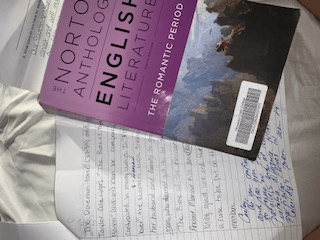
At first glance, James Ward’s painting Gordale Scar seems consumed by tall limestone cliffs, but with a closer examination of the title, the paintings subtitle, and the painting itself, the painting comes to life. The rolling clouds of thunder above the cliffs and the animals grazing among the base of the cliffs give the painting a dark and beautiful elegance. In between the cliffs is water running off from an ancient glacier. Readers who experience the painting of Gordale Scar along with the book Frankenstein, written by Mary Shelley, may see a vivid connection as both were written during the Romantic Period. As Shelley writes, “I could hardly see the dark mountains” (57) talking about the darkness in Victor Frankenstein’s life. Shelley in the book Frankenstein, talks about the “creation and design of living organisms” (Shelley xvii). These two works from the Romantic Period correspond with one another in many different ways.
Gordale Scar, James Ward, ca. 1812-14 / W.W. Norton
References
Shelley, Mary. Frankenstein. Introduction and Notes by Karen Karbiener. Barnes and Noble, 2003.
Ward, James. Gordale Scar. The Norton Anthology of British Literature: The Romantic Period. 10th ed. Stephen Greenblatt, General Editor. W. W. Norton, 2017. p. C4.
This is the first post on my new blog. I’m just getting this new blog going, so stay tuned for more. Subscribe below to get notified when I post new updates.
“A Christmas Carol” by Charles Dickens was published on December 19th, 1843. The story is about a repugnant man named Ebenezer Scrooge, who is taken through trials and learns many lessons throughout the story by three ghosts. At the beginning of the story, Scrooge was described as “a squeezing, wrenching, grasping, scraping, clutching, covetous, old sinner! Hard and sharp as flint, from which no steel had ever struck out generous fire; secret, and self-contained, and solitary as an oyster” (stave 1). The ghost’s names are the Ghost of Christmas Past, the Ghost of Christmas Present, and the Ghost of Christmas Yet To Come. At the end of the story, Scrooge has turned his life around and is jovial and generous. Scrooge described himself at the end by saying, ”I am as light as a feather, I am as happy as an angel, I am as merry as a schoolboy. I am as giddy as a drunken man” (stave 5). The trials Scrooge is taken through and the lessons he learns are written in three letters addressed to each ghost.
Dear Ghost of Christmas Past,
Since I am sequestered at home, I have a lot of time on my hands. I am writing to say thank you for visiting me on that cold dark night. Marley’s Ghost had warned me about you coming to see me and I had anxiously waited for your arrival. You took me down memory lane and reminded me of my childhood and who I use to be. I was so confused as to why you had to come to remind me of all of those painful and joyful memories, but now I understand. I have been visited by the Ghost of Christmas Present and the Ghost of Christmas Yet To Come and it has been revealed to me why you came to see me in the first place. You reminded me of my family and friends and how joyful Christmas could be. I was reminded of all of the beautiful Christmas smells and traditions. You also reminded me of how greedy and lonely I had become. You showed me memories that made me feel empathy for those neglected. Before I was visited by you and the other ghosts I would have been beyond joyful to stay at home alone, but now after all the ghosts have visited me, I can not wait to go and see all of my friends and family. Thank you for helping me become the generous and jovial man I am today.
Sincerely Sequestered,
Scrooge
Dear Ghost of Christmas Present,
I am writing to say thank you for visiting me and thank you for all you have done for me. I remember the night that you came, I awaited your arrival and thought I was prepared. I was not prepared at all, you showed up in a flash of light, dressed in a green garment, and you were surrounded by a feast of food. I was more accepting of meeting you than the ghost of Christmas past and was excited to see what lessons I would learn. You took me around town and showed me how joyful and excited everyone was about Christmas. There was not one unhappy soul in town. Next, you took me to see Tiny Tim who always makes the best out of any situation despite his disability. My soul was softened by this because his family remembered me during their dinner. They thought about me and wished the best upon me, even when I did not do the same to them. I was so heartbroken to find out that Tiny Tim would not make it in the future, but I was soon relieved to know that if the present changes then he would! You then took me to see my family, who remembered me too and they were joyful. They made jokes about me, but in the end, they only wanted the best for me. This made me very jovial. I was changed dramatically from this experience and my soul was softened. You showed me how important family is and I learned how important generosity is to the people around me.
Sincerely Sequestered,
Scrooge
Dear Ghost of Christmas Yet To Come,
I am writing to thank you for everything you have done for me! Since I am sequestered at home I have had a lot of time to think about all of the lessons I have learned from the ghost of Christmas past, the ghost of Christmas present, and from you. When I met you, you would not speak to me and I feared you. I was thankful that you had come and I was prepared to see what you were going to show me. You never said a word to me as you glided along in your dark black cloak. You showed me a funeral scene and showed me three people going through the belongings of the deceased. Next, we went to the Cratchit household where Tiny Tim had died. I never want my life to end in such a miserable way. I am so thankful that you showed me what I was going to become if I did not change my ways. I pledged to you that day that I was going to change my ways so that my future would be altered. As soon as you left I felt by burdens leave, I was light-hearted, giddy, and excited. I was consumed by tears and laughter all at once. I went into the streets and congregated with all of the wonderful people. I gave Bob Cratchit a much-deserved raise and helped his family out. Tiny Tim didn´t die and I became like a second father to him. My heart is now joyful again and I love Christmas!
Sincerely Sequestered,
Scrooge
Works Cited
Dickens, Charles. A Christmas Carol. 1843. Project Gutenberg,
The poems, “The Daemon-lover” and “The Rime of the Ancient Mariner” by Samuel Taylor Coleridge, present several parallels and a few notable differences. In “The Daemon-lover,” a woman, who was a wife and a mother, leaves her family to fill her desires with a new man. She was deluded, the man turned into the devil and she was condemned to hell. In “The Rime of the Ancient Mariner,” the mariner killed an Albatross, a bird known for good fortune. This brought a curse onto the ship, the wind ceased and the ship halted to a stop in the middle of the ocean. All of the sailors on the ship, but the ancient mariner died. The mariner had to live in constant agony after the incident because everyone wanted to hear the story of the ancient mariner. Each poem exhibits someone committing a reprehensible action and having to deal with the repercussions it; however, the rationale behind each person’s action and the repercussions they face because of their action defer.
In the poem ¨The Daemon-lover,¨ the woman encounters the Devil in disguise and falls into his trap. The Devil said to the woman, ¨I hae seven ships upon the sea, / The eighth brought me to land; / With four-and-twenty bold mariners, / And music on every hand¨(30). She decided to follow him onto the ship and soon after she was condemned to hell. Similarly in ¨The Rime of the Ancient Mariner,” the ancient mariner went to sea with about two hundred other mariners and regrettably shot an albatross, which is known to bring good fortune. The poem takes place at a wedding party where is forced to tell his story of what happened on that ship. On the ship, the ancient mariner was forced to hang the carcass of the albatross around his neck. All of the other two hundred mariners died on board the ship, while the ancient mariner was the only one left alive to tell the horrific story of what happened on board of the ship. Similarly, both the woman and the ancient mariner caused death. The woman was condemned to hell and the mariner had everyone around him on board the ship die before his eyes. These deaths were caused by the actions that both the woman and ancient mariner committed. The rash decisions that the woman and the ancient mariner made endlessly caused agony upon them.
Although, both of the poems are very similar to one another and they both have a similar story to tell. There are some differences between the storylines of ¨The Rime of the Ancient Mariner¨ and ¨The Daemon-lover.” The ancient mariner made an appalling impulse decision to kill the albatross by himself; ¨The Rime of the Ancient Mariner¨ states, ¨With my cross-bow I shot the albatross¨(80). In contrast, the woman was outwitted and fell for the ruse set up by the Devil. Another major difference in the plots of each poem is who suffered because of the main character’s decisions. In ¨The Daemon-lover,¨ the woman says, ¨If I was to leave my husband dear, / And my two babes also, / O what have you to take me to, / If with you I should go?¨(25). When she decided to leave with the man, who turned out to be the Devil, her husband and her children suffered because of her decision. In ¨The Rime of the Ancient Mariner,¨ all of the other mariners on the ship suffered and died because of the ancient mariner’s decision. Unlike the woman in ¨The Daemon-lover,¨ the ancient mariner was left alone aboard the ship to manage his guilt, while the woman was drowned at sea after following her desires. While these poems have numerous similarities within the plot, they also have notable differences.
Within the lines of both ¨The Daemon-lover¨ and ¨The Rime of the Ancient Mariner,¨ there are many parallels and differences. Similarities between the two poems would be that both of the main characters made rash decisions with regretful consequences and each poem’s actions caused death in some form. Differences between the two poems would be that the ancient mariner made an impulse decision by himself and that the woman was conned into leaving her family behind. Another difference would be that the ancient marinerś actions caused all two hundred other mariners to suffer and die and he lived to tell the agonizing story repeatedly for the years to come, while the woman left her family behind causing them to suffer, but she was drowned and condemned to hell. There are many ideas that live in the lines of Coleridge’s poem that are seen echoed throughout the poem of ¨The Daemon-lover,¨ while there are also some significant differences between the two storylines.
Works Cited
Coleridge, Samuel Taylor. “The Rime of the Ancient Mariner.” The Norton Anthology of British Literature: The Romantic Period. 10th ed. Stephen Greenblatt, General Editor. W. W. Norton, 2017. pp. 448-64.
¨The Daemon-lover.¨ The Norton Anthology of British Literature: The Romantic Period. 10th ed. Stephen Greenblatt, General Editor. W. W. Norton, 2017. pp. 37-39.
This is an example post, originally published as part of Blogging University. Enroll in one of our ten programs, and start your blog right.
You’re going to publish a post today. Don’t worry about how your blog looks. Don’t worry if you haven’t given it a name yet, or you’re feeling overwhelmed. Just click the “New Post” button, and tell us why you’re here.
Why do this?
Because it gives new readers context. What are you about? Why should they read your blog?
Because it will help you focus you own ideas about your blog and what you’d like to do with it.
The post can be short or long, a personal intro to your life or a bloggy mission statement, a manifesto for the future or a simple outline of your the types of things you hope to publish.
To help you get started, here are a few questions:
Why are you blogging publicly, rather than keeping a personal journal?
What topics do you think you’ll write about?
Who would you love to connect with via your blog?
If you blog successfully throughout the next year, what would you hope to have accomplished?
You’re not locked into any of this; one of the wonderful things about blogs is how they constantly evolve as we learn, grow, and interact with one another — but it’s good to know where and why you started, and articulating your goals may just give you a few other post ideas.
Can’t think how to get started? Just write the first thing that pops into your head. Anne Lamott, author of a book on writing we love, says that you need to give yourself permission to write a “crappy first draft”. Anne makes a great point — just start writing, and worry about editing it later.
When you’re ready to publish, give your post three to five tags that describe your blog’s focus — writing, photography, fiction, parenting, food, cars, movies, sports, whatever. These tags will help others who care about your topics find you in the Reader. Make sure one of the tags is “zerotohero,” so other new bloggers can find you, too.